


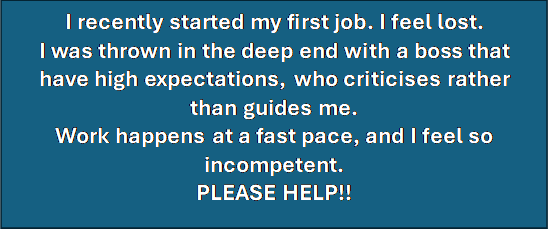
That sounds really hard — and honestly, very common for a first job.
I’m really glad you said it out loud. ?
Feeling lost in this situation does not mean you’re incompetent.
A few things I want to gently ground you in first:
1. What you’re experiencing is not a personal failure
You:
- are new
- weren’t properly guided
- are working in a fast-paced environment
- have a boss who critiques more than coaches
That combo would make almost anyone feel inadequate.
Even people with years of experience struggle when they’re “thrown in the deep end” without support.
Your nervous system is basically in survival mode, not “learning mode.”
2. Criticism without guidance or useful feedback
When a boss points out what’s wrong but doesn’t show you:
- what good looks like
- how to get there
- what’s expected at your level
…it creates confusion, not growth. That’s a leadership gap — not a reflection of your intelligence or capability.
3. First jobs are especially brutal
No one tells you this clearly enough, but your first job is often the hardest emotionally:
- Everything is new (tools, language, norms, politics)
- You don’t yet trust your own judgment
- You’re comparing yourself to people who’ve been there for years
- You feel like you’re “behind” all the time
That doesn’t mean you are behind. It means you’re learning.
4. That “I feel incompetent” feeling has a name
It’s very likely a mix of:
- Imposter syndrome (“Everyone else knows what they’re doing except me”)
- Cognitive overload (too much new info too fast)
- Lack of psychological safety (criticism without support)
Those feelings are signals, not truths.
If you’re open to it, here are a few gentle, practical things that can help right now, even if your boss doesn’t change:
Micro-wins > perfection
Each day, pick one small thing to get better at or understand more clearly. Progress compounds quietly.
Externalise the chaos
Write things down obsessively:
- processes
- corrections
- “mistakes” and what you learned
Seeing it on paper helps you realise you are improving — your brain just forgets under stress.
Ask clarifying, expectation-based questions
Instead of “Am I doing this right?” try:
- “What does a good version of this look like?”
- “What should I prioritise if time is tight?”
- “Is this something you expect me to know already, or learn as I go?”
That subtly shifts responsibility back to where it belongs.
Separate you from your performance
You are not your current output. You are a person in a learning phase. Those are very different things.
I want to ask you just one question, because it can help me support you better (and you don’t have to answer perfectly):
What makes the days hardest right now — the workload, the boss’s behaviour, or your own self-doubt?
Reference List — Understanding What You’re Feeling
1. Imposter Syndrome
-
Clance, P. R., & Imes, S. A. (1978). The imposter phenomenon in high achieving women: Dynamics and therapeutic intervention. Psychotherapy: Theory, Research & Practice.
This paper first defined imposter feelings — common in high pressure and new environments. -
Sakulku, J., & Alexander, J. (2011). The Imposter Phenomenon. International Journal of Behavioral Science.
A summary of why competent people feel like frauds.
2. Psychological Safety & Feedback
-
Edmondson, A. (1999). Psychological Safety and Learning Behavior in Work Teams. Administrative Science Quarterly.
Shows that safe environments — where people can ask questions without fear — improve performance and learning. -
Stone, D., & Heen, S. (2014). Thanks for the Feedback. Penguin Random House.
Explains how humans react to criticism versus coaching.
3. Cognitive Load and Learning
-
Sweller, J. (1988). Cognitive Load Theory and the Learning Process. Educational Psychology.
Explains why too much new information at once can make even bright people feel overwhelmed. -
van Merriënboer, J. J. G., & Sweller, J. (2005). Cognitive Load Theory and Complex Learning. Educational Psychology Review.
Shows how breaking tasks into smaller pieces helps learning.
4. Growth Mindset
-
Dweck, C. S. (2006). Mindset: The New Psychology of Success. Random House.
Describes how focusing on learning and growth leads to more resilience in challenging situations.
5. First Jobs & Transition to Professional Life
-
Schlossberg, N. K. (1981). A Model for Analyzing Human Adaptation to Transition. The Counseling Psychologist.
Provides a framework for understanding major life changes like starting a job.